This guide is for brands, distributors, and importers that source and sell cellular kids smartwatches. It explains what to check when selecting SIM options, verifying local carrier compatibility, and preparing 4G models for local market launches.
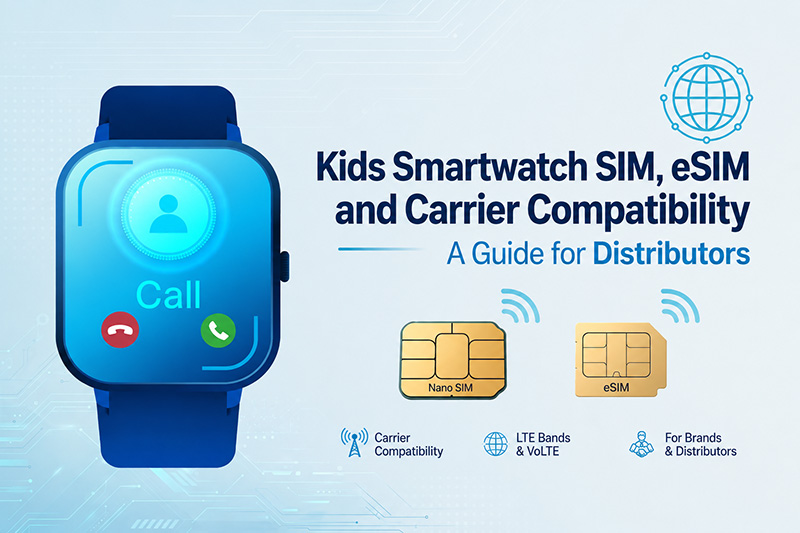
How They Differ
A nano SIM is a small card you can remove from the watch's SIM slot. Almost every carrier supports nano SIMs.
Wonlex uses the plug-in approach. For background on that choice, see our article on why Wonlex watches support eSIM. An eSIM does not mean the watch will work with any carrier. The target carrier has to offer eSIM profiles for this type of device, so ask the supplier who provides and manages the profiles, and which carriers have been tested.
Effect on SKUs and Stock
The choice between nano SIM and eSIM can affect how distributors manage product configurations and stock. With nano SIM models, distributors may need to source SIM cards separately from local carriers or connectivity providers. With eSIM models, the eUICC is either built into the device or supplied as a plug-in eSIM card, and carrier profiles can be provisioned remotely if the device and service provider support it. There is no carrier-specific SIM stock to hold, but someone has to supply and manage the profiles.
A single hardware SKU may support multiple carriers if its LTE bands and hardware are compatible, but you may still need separate firmware or network configurations. Different hardware variants or bundled connectivity options may also require separate SKUs, depending on the supplier's product setup.
Activation and After-SalesFor nano SIM models, activation usually involves inserting the SIM card into the watch, although some carriers may require additional steps, such as SIM registration or APN configuration. The SIM may be provided and activated by you, the retailer, the carrier, or the parent, depending on the sales arrangement.
With Wonlex eSIM watches, the user needs a Wi-Fi connection and a carrier-provided QR code or activation code to download and install an eSIM profile. The setup and service activation documents should explain these steps clearly, including how to disable or delete an existing profile when necessary. Switching carriers means swapping the card on a nano SIM model, or downloading a new profile on an eSIM model. Deleting an eSIM profile from the watch does not automatically cancel the associated carrier subscription. The account holder may need to contact the carrier to deactivate or transfer the subscription before the watch is returned or prepared for resale.Countries, and sometimes carriers within the same country, use different 4G (LTE) bands. A watch labelled "4G" will not necessarily work with every carrier you need.
Why VoLTE Matters
VoLTE (Voice over LTE) carries voice calls over the 4G network. Even when the supplier confirms that a watch supports VoLTE, the carrier also has to enable VoLTE on its network for that device.Not all 4G kids watches support VoLTE, and some carriers only allow approved devices on their network. Test calls on each target carrier's network before launch.
Do not assume emergency calls will work because a normal voice call does. Ask both the supplier and the carrier to confirm. Also check what the SOS button does on the model you buy: on many kids watches it calls preset family numbers, not an emergency number.
2G and 3G Shutdowns
A watch without VoLTE falls back to 2G or 3G for calls. Many markets have already switched off 3G, and some are now switching off 2G. In the UK, for example, the main carriers have closed their 3G networks, and 2G is due to be shut down by 2033. Dates differ by country and carrier, so check them for each target market.Once the watch is approved for the market, the next question is how it reaches buyers. Kids smartwatches can be sold through retailers without a carrier agreement, as long as they work on the main local networks with the customer's own SIM.
However, it can sometimes be worth exploring a partnership with a carrier to sell through its retail shops or to bundle the watch with a plan. You would need to pass the carrier's device testing, but smaller distributors may find MVNOs or connectivity providers easier to negotiate with on lower volumes of stock.Watch and Plan Bundles
A bundled offer is sold to parents as a complete solution that works out of the box. The package usually includes a SIM card or eSIM profile, sometimes a free first month of service, and a plan bought together with the watch.
Selling a bundle means taking on more responsibility. You need a carrier arrangement, and you need to explain clearly when the service starts, when any included period ends, and who bills the parent after that.
Prepaid or Monthly PlansMonthly plans give parents a regular payment schedule and avoid the need for frequent top-ups. Prepaid plans give more control over spending and no ongoing commitment, but the offer has to explain clearly how top-ups work and when credit expires.
Make sure the selected plan supports all the watch's intended functions, including voice calls, video calls, and mobile data where applicable. Low-cost data-only or IoT plans may not include voice at all, or only as a separate option. Without it, the watch cannot make normal calls or SOS calls.
Some distributors use a global or roaming SIM to cover several countries with one provider. This saves arranging SIMs market by market, but check that long-term use is allowed in each country, as some carriers limit permanent roaming, and that voice is included, not only data.
Working with Retailers and CarriersA kids smartwatch sale can involve the supplier, the distributor, the retailer, and the carrier. Write down every step from device setup to service activation, and name who is responsible for each one if something goes wrong.
If no one is clearly responsible for providing or activating the service, parents may end up contacting multiple companies to resolve an issue. Before launch, test the complete process with a sample unit to identify potential problems and confirm that each party knows its responsibilities.The answer starts with separating what the device costs from what the network costs. The purchase price of a kids watch does not include mobile service charges for calls, texts, and data. While some prepaid mobile plans do not have a monthly bill, they do need to be 'topped up' from time to time. In addition, some parent app subscription charges may also need to be paid on top of the cost of the mobile service plan itself.
Show the price of the device itself and the price of the SIM, activation, mobile services, etc. If a plan is included, say how long it lasts and what the buyer pays after that. For example: "This watch has no subscription from us. You will need to get a compatible mobile plan for voice and data." Make sure this text is accurate to what you are actually offering. For the questions parents ask most often, such as whether a kids watch needs a SIM card or a monthly plan, see our kids GPS smartwatch FAQ.A watch will work with a carrier's SIM cards if it supports the carrier's LTE bands, if VoLTE is available for it on that network, and if the carrier does not block unapproved devices. Check the watch's full band list against the bands your target carriers use.
Do All 4G Kids Smartwatches Support VoLTE?No. Many 4G kids smartwatches support VoLTE, but not all do. Even when a model supports it, the carrier has to enable VoLTE for that device. Watches without VoLTE fall back to 2G or 3G for calls, and those calls stop working where the older networks are switched off. Ask the supplier which models support VoLTE and test calls on each target carrier. The Wonlex KT36, for example, supports 4G VoLTE calling, but check that each target carrier enables it for the device.
Can One Model Support Both Nano SIM and eSIM?Yes, some can. Wonlex lists both options for the KT36 and KT38. Wonlex's activation guide describes a plug-in eSIM card that can be used in place of a standard SIM card for supported watches. Ask Wonlex which setup applies to the exact model you're ordering, what's included, and how activation and switching work in your market.
What Should Distributors Check Before Ordering for a New Market?
Ask the supplier for the full LTE band list of the regional version, VoLTE support by carrier, any carrier test reports, eSIM details if used, and APN settings for your target carriers. Check regulatory approvals and approval by individual carriers where required. Test a sample with the planned nano SIM and eSIM plans, agree on the activation process, and decide who will manage returns.