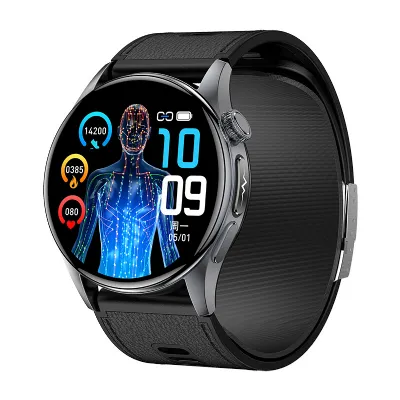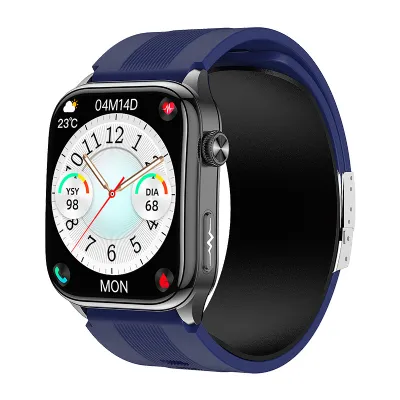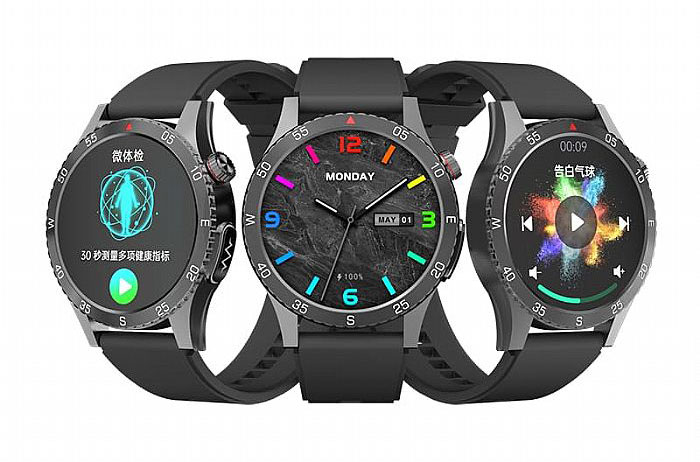
What Are the Factors of ECG Smart Watch Accuracy?
Heart rhythm and irregularities can be detected using an ECG (Electrocardiogram) smartwatch, whose accuracy is based on several fundamental factors. They can be useful in providing information regarding the heart, but their effectiveness depends on the technology and the user. Below are some factors that determine the accuracy of ECG smartwatches:
1. Sensor Quality and Placement
Sensors, the primary instrument of ECG smartwatches, need to be updated with high-quality sensors. These sensors detect the heart's electrical activity and convert it into meaningful, visible information. Low-grade or poorly done sensors may cause wrong readings or not capture the whole heart activity.
Proper placement of the watch on the wrist is also something significant. The sensors must be on the skin's surface, mainly over the wrist, to pick the heart's electrical frequencies. If the device is placed loosely or in the wrong location, this will lead to invalid results or inadequate information collection.
2. Algorithm and Data Processing
ECG smartwatches use algorithms to interpret the data captured by the sensors. Such algorithms assess the heart's electrical activity and conclude if it indicates an arrhythmia or associated heart disease. An advanced, well-trained algorithm would be able to distinguish between normal and abnormal heart rhythms, hence decreasing the false-positive and negative rates.
These algorithms are typically improved through machine learning from clinical trials. The studies showed that the algorithm's performance would vary even among various brands and models of smartwatches.
3. Skin and Environmental Conditions
Other factors affecting the accuracy of ECG smartwatches are the user's skin type and environmental factors. For example, if a person has too dry or oily skin, the moisture will reduce the capacitive interaction of the sensors, leading to improper readings. Excessive movements, sweating, or moisture can cause signal interruptions and lower ECG data quality.
Environmental parameters, such as temperature, also affect the sensors' performance. Extreme cold or hot conditions could cause them to not work at their full capacity.
4. Battery Life and Performance Stability
The other factors are the wearable device's battery life and overall performance stability. Devices operating on low batteries might not be able to power their sensors and algorithms fully, which could lead to erroneous or incomplete readings and diagnoses. Also, the device's system design may limit accuracy over time because software bugs interrupt the signal process and data capture.
5. User Activity and Motion Artifacts
One of the biggest challenges for ECG smartwatch accuracy is motion artifacts—distortions in the ECG signal caused by movement. If the user is in motion, the sensors may pick up additional noise, making it difficult for the algorithm to detect heart signals correctly. For accurate ECG readings, it is usually recommended that the user remain still and ensure proper contact between the watch and the wrist.
6. Regulatory Approvals and Clinical Validation
The most available and applicable types of ECG smartwatches have usually been cleared or approved by agencies like the FDA and other regulators. These clearances have already been tested clinically and achieved certain metrics. Watches without such legal warrants may not have reached levels.
The Use ECG Smart Watch for Seniors with Arrhythmia
Atrial fibrillation (AF) is the most common form of heart rhythm disorder and is responsible for almost a quarter of stroke cases in America. Various studies, including Tison et al., have recently shown that smartwatches with ECG functions can find AF.
With increasing globalization, wearable devices are also becoming embraced in medicine. Smartwatches with ECG capabilities allow users to record and transmit single-lead electrocardiograms (ECGs), making them a valuable tool for monitoring heart health. Although current smartwatch ECGs primarily screen for atrial fibrillation, research has focused on their potential to diagnose not only AF but also other arrhythmias and heart conditions.
For seniors with arrhythmia, ECG smartwatches provide the advantage of monitoring heart rhythms regularly and easily. For instance, they can automatically detect atrial fibrillation or record an ECG, helping to catch irregularities early. However, the user must be conscious and aware to take a reading, which may limit their use in certain situations.
Younger, healthy individuals also use these devices widely, opening up new possibilities for detecting rare heart conditions that may increase the risk of sudden cardiac events. While most smartwatch users are adults, some studies have shown that newborns and children can benefit from these devices in specific cases.
Today, many over-the-counter ECG smartwatches allow users to register ECGs anytime and anywhere, often syncing with a smartphone for easy data storage and sharing. Although most research has focused on atrial fibrillation and arrhythmias, early studies suggest these devices can detect other cardiac conditions.
While ECG smartwatches are not a substitute for clinical-grade devices, they are a promising tool for seniors with arrhythmia. They offer a convenient and accessible way to monitor heart health, particularly for detecting atrial fibrillation, and may pave the way for broader cardiac diagnostics as technology evolves.
Are The ECG Data Recorded by Smartwatch Valid for Cardiologist?
We can visualize ECG data using the Phyton program. Python can display ECG data from a smartphone or wearable. Recordings must be saved in text format and inserted into the software.
Answering the question, yes, ECG data recorded by a smartwatch can be used for cardiologist inspection.
The two numbers crucial to ECG data recording are sensitivity and specificity. Sensitivity is the ability to identify only a portion of all affirmative cases that are accurately identified.
On the flip side, specificity indicates that certain individuals are identified as positive even if they are negative out of all the negative cases.
ECG smartwatches will become dependable instruments assisting cardiologists in identifying heart disease cases.
However, wearable device-based detection approaches can be more sensitive and specific by utilizing sensitivity measurements and artificial intelligence.
So, does this mean that the ECG smartwatch is reliable?
If the smartwatch tells you that the heart's functioning is abnormal, you should go to a medical center. There, they will perform a complete ECG, using machines specifically designed for this function, to clear up any doubts. The ECG on smartwatches indicates that something is not working properly; it is not an infallible measure that will save our lives.
To sum up, they are generally reliable but have limitations. Just because a smartwatch ECG comes out OK doesn't mean you're not having a problem because it only measures your wrist.
Some FDA-approved mobile ECG devices that work with smartphones and smartwatches are already on the market. Users can record and share ECG readings with healthcare providers using third-party apps available for iOS and Android platforms.
What Are The Benefits of ECG Smart Watches?
In general, the greatest benefit of a smartwatch is its seamless connection. Smartwatches are easy to pair with smartphones, tablets, and other Bluetooth-capable devices, so users can have a hassle-free experience. Furthermore, Bluetooth improves the functionality of smartwatches. Many options range from managing music playback on the phone to receiving notifications. These watches improve the user experience to the point that they become essential to our daily lives.
Specifically, ECG smartwatches offer more benefits, such as:
- Checking the high-risk population for atrial fibrillation (AF).
- AF screening in individuals with cryptogenic stroke.
- Direct access to individualized health measures empowers patients.
- We are helping AF management (drug titration, pill therapy direction, recurrence assessment).
- Assessment of palpitating patents.
- Assessment of lifestyle change and coaching/education provided by mHealth regarding AF's burden and recurrence rate.
- Investigate deep neural network patterns in the electrocardiogram (ECG) that may indicate future health outcomes.
The benefits of an ECG detector and other functions like trip, slip, fall, or crash detectors will help users in emergencies. For example, if the users have abnormal heart activity, followed by a fall and no response, the smartwatch can immediately contact emergency numbers for immediate help.
With all of those benefits, ECG smartwatches also face some challenges, such as:
- Cost and availability.
- False negatives and false positives. Particularly for those patients whose anxiety may potentially impact their heart rate.
- Inability to monitor while users are physically active, absence of ongoing monitoring, restrictions on HR, and constraints imposed by other underlying rhythms.
- Security and privacy of personal information produced by consumer wearables.
- It is a single-lead ECG system, while doctors usually use the 12-lead ECG.
How Useful Is The ECG Smart Watch?
ECG smartwatches are typically paired with an app that automatically classifies heart rhythms, including detecting atrial fibrillation (AF). The U.S. Food and Drug Administration (FDA) has cleared the algorithms used in these devices for identifying AF, highlighting their potential as health monitoring tools. However, as these direct-to-consumer devices become more popular, several important questions arise regarding their role in clinical practice.
One concern is how the data collected by ECG smartwatches can be effectively used to improve patient care. While these devices offer easy access to heart health monitoring, it remains unclear how healthcare providers can best integrate this information into treatment plans. Additionally, there are ongoing concerns about the security and safety of wearable technology.
Another issue is determining whether the ECG feature on these smartwatches will meaningfully impact public health. While they provide valuable insights, it's important to understand their long-term benefits and limitations, especially in large-scale health outcomes.
We are entering an era of mobile technology rapidly transforming clinical practice, and ECG smartwatches may influence various aspects of cardiovascular care. As these technologies evolve, their role in diagnosing and managing heart conditions will likely become clearer.